

Womb cancer (also known as endometrial or uterine cancer) affects around 10,000 people every year in the UK… that’s 27 people every day. It is the fourth most common cancer in UK women (after breast, bowel and lung).
Despite this, awareness remains low, with over half of UK adults (55%) saying they know little or nothing about the disease.*
Our recent survey highlights some of the reasons people may delay seeking help for possible womb cancer symptoms:
- Almost half of women (49%) said difficulty getting a GP appointment would be a barrier to seeking medical advice
- But a similar number (45%) said they would wait to see if symptoms resolved on their own
- 43% said they may not recognise symptoms as something to worry about
- 1 in 4 women (25%) worried about wasting their GP’s time
This year, Peaches aims to change that, so more people feel confident that if something is not normal for you, your GP wants to know.
>> See our Toolkit for more support
*With support from a Small Charity Research Award in partnership with nfpResearch, we commissioned a nationally representative survey of 1000 UK adults. The findings help shape our work and inform this year’s Womb Cancer Awareness Month campaign.
The most common symptom
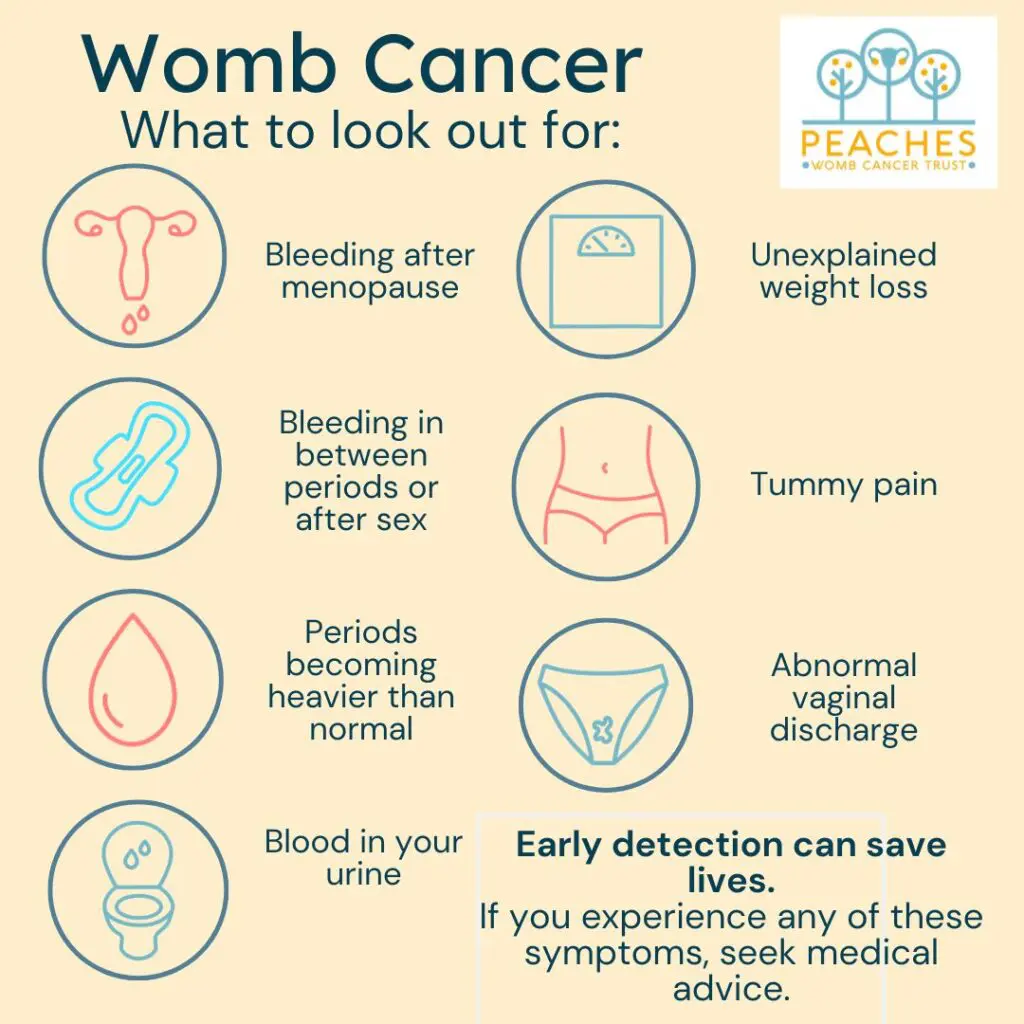
The most common symptom of womb cancer is unusual vaginal bleeding. This includes:
If you are post-menopausal (no periods for 12 months or more):
Any vaginal bleeding at all — including spotting, pink, red, brown or watery discharge. Even if it happens once or is a small amount.
If you are pre-menopausal:
- Heavier periods than usual
- Bleeding between periods
- Bleeding after sex
- Unusual vaginal discharge
- Persistent pelvic or tummy pain
These symptoms can have many causes and do not necessarily mean cancer. However, it is important to get them checked by your GP, especially if they are new, persistent or not normal for you.
Why getting checked matters
Womb cancer is most commonly diagnosed in women over 50, but it can affect younger people too.
The good news is that womb cancer is often highly treatable when found early.
- When diagnosed at stage 1, 92% of people will survive for at least 5 years.
- However, when the disease is diagnosed at a later stage 4 this figure reduces to 15%.
[ONS and Public Health England].
That’s why recognising symptoms and speaking to your GP sooner rather than later is so important.
Many people hesitate to seek help because they worry they are overreacting, wasting an appointment, or not being taken seriously. But GPs want to hear about symptoms like unusual bleeding. In most cases it won’t be cancer – but it is always worth checking.
If your GP needs to investigate further, they may arrange tests such as blood tests or an ultrasound scan, and if cancer is suspected you will usually be referred urgently so you can get the right care in place as quickly as possible.
If it’s not normal for you, it’s worth getting it checked.
Take action
If you notice any symptoms that are new, unusual, or not normal for you, please contact your GP. Your GP wants to know.
You can also explore our toolkit and resources, below, for practical support.

Toolkit #YourGPWantsToKnow
We’ve created and collected resources to help you, or someone you know, recognise the signs of womb cancer, understand what help is available and take action:
Join us on social media this Womb Cancer Awareness Month by liking, sharing and commenting on our campaign posts using #YourGPWantsToKnow and #WombCancerAwarenessMonth to help spread awareness of womb cancer symptoms.
We’ve created a special Womb Cancer Awareness Month signs and symptoms graphic for you to share on social media to help raise awareness of womb cancer symptoms and encourage earlier diagnosis.
>> Download the flyer to share on your account
Feel free to use the wording below or make it your own — what matters most is sharing the message:
If it’s not normal for you, your GP wants to know. Spot the signs of womb cancer.
This Womb Cancer Awareness Month, I’m supporting Peaches Womb Cancer Trust to help raise awareness of the signs of womb cancer. Please talk to your GP if something doesn’t feel normal for you, especially any vaginal bleeding after the menopause, after sex or in between periods.
@peaches_trust #YourGPWantsToKnow #WombCancerAwarenessMonth #UCAM
We’re also proud to be supporting global awareness initiatives alongside organisations including IGCS, ESGO and World GO Day.
You can take part in the global uterine (womb) cancer awareness campaign by sharing a photo or video of a #Jump4June.
Don’t forget to tag @peaches_trust @IGCANetwork and use the hashtag #UCAM.
>> Find out more: igcs.org/jump4june
1. Spotting the Signs
Learn about the signs and symptoms of womb cancer, including abnormal vaginal bleeding, and access tools to help you keep track of symptoms:
Peaches is here for you.
>> Explore our website to learn more about the signs and symptoms of womb cancer.
>> Download our printable symptom tracker to help make a note of any symptoms you experience.
This can be helpful when recognising patterns or explaining symptoms to your GP.
Feel free to print it out and colour code the symptoms or jot down any notes. You can also keep track of symptoms in a notebook or notes app on your phone.
If you experience any of these symptoms do not hesitate to seek medical advice. Any unusual bleeding, any time, your GP wants to know.
2. Speaking Up
If something doesn’t feel right, trust yourself. These resources can help you feel more confident speaking to your GP and advocating for your health:
>> Read our guide to speaking up for your health and feeling more confident when discussing symptoms and concerns with your GP.
Vaginal bleeding after the menopause is called post-menopausal bleeding (PMB) and should never be ignored.
>> Download The Royal College of Obstetricians & Gynaecologists poster about PMB for more details
Womb cancer can affect younger people too. If you’re still having periods, you can complete a short online symptom checker created by our friends at Wellbeing of Women.
Take the Quiz | Not “Just a Period”It takes around 5 minutes and gives you a personalised letter you can use when speaking to your GP. You’ll be asked for your email address so your results can be sent to you.
If you are post-menopausal, or would like more guidance on womb cancer, our symptom information page explains what to look out for and when to contact your GP.
3. Knowing the Pathway
You know your body best. Understanding how GP care should work can help you feel more confident seeking support, speaking up about your symptoms and navigating the healthcare pathway. You have the right to be heard.
These resources explain how appointments are accessed and how ongoing symptoms are reviewed:
GP care in the UK is guided by national access standards, but services are organised slightly differently across each UK nation.
In England, GP practices must offer three ways to get in touch during core hours (8.00am–6.30pm):
- Visiting the practice
- Calling the practice
- Contacting the practice online
These options should be clearly explained in a Patient Charter on the practice’s website – now called You and Your General Practice (YYGP).
When you get in touch, practices will ask for key information to understand your needs and make sure you are directed to the right care. People are then prioritised based on clinical need, rather than on a first-come, first-served basis.
GP practices also work as part of a wider team, including nurses, pharmacists and other healthcare professionals, to make sure patients are seen by the most appropriate person.
These systems are designed to help ensure that people with urgent symptoms are prioritised and everyone can access care when they need it.
>> Find out more about GP Access Standards where you are:
If you are ever unsure, it is always okay to contact your GP for advice.
Named after Jessica Brady, who tragically died aged 27 after more than 20 GP appointments without referral, Jess’s Rule has been rolled out across GP surgeries in England to help make sure persistent symptoms are taken seriously and properly investigated.
If you have seen your GP three or more times with the same ongoing, unexplained or worsening symptoms, your doctor must “reflect, review, and rethink” your case. This may include arranging further tests or scans, carrying out an examination, seeking a second opinion or referring you to a specialist.
If you’ve spotted symptoms, used the resources above, and spoken to your GP, they might feel further checks are needed.
>> Read more information about womb cancer tests on our website
Most people are not diagnosed with cancer, but these steps help make sure anything that is going on is properly understood as quickly as possible.
>> Cancer Research UK also explains the referral pathway guidelines across the different UK nations
If you do not think your symptoms are being taken seriously, you can contact your GP again and ask for more tests or to see a specialist.
Remember, if you do receive a diagnosis of womb cancer, you are not alone — Peaches is here for you.
About Peaches
Peaches Womb Cancer Trust works to improve the lives of those affected by womb cancer by raising awareness, supporting and advocating for patients, and funding and promoting research.
We want to change outcomes by improving awareness, supporting earlier diagnosis, and ensuring more people feel confident seeking help when something doesn’t feel right.
You can also support Peaches by fundraising or making a donation to help us continue our vital work.
DonateIf you have any feedback about our campaign or toolkit, please do send us an email at [email protected]. We would love to hear about people’s experiences of using the toolkit, and whether they have supported you in learning more about womb cancer, or progressing towards a diagnosis.
Thank you!